September 4, 2026
10 min read
High-Volume Hiring in Turkey: The 2026 Guide for TA Teams




September 4, 2026
10 min read
Turkey's high-volume hiring market is entering a defining moment, shaped by scale, speed, and a new kind of candidate behavior. Demand for multilingual talent has surged, inflation has reshaped compensation expectations, and global employers have intensified their hiring in Istanbul, Ankara, Antalya, and emerging talent hubs across the country.
But the real story isn't just growth. It's how quickly the talent market has changed underneath it. Candidates today are mobile-first, WhatsApp-first, and often completely CV-free. It's not that talent isn't out there; it's that the traditional ways of reaching, screening, and engaging them no longer keep up with how they actually behave. Recruiters are frequently working with nothing more than a name and a phone number, which makes early screening messy, repetitive, and hard to scale with the tools most TA teams were using five years ago.
And even with the right candidates in the pipeline, the competition has become fierce. New entrants frequently use aggressive salary strategies to attract talent quickly, while established players must rely on stronger employer branding, better candidate journeys, and faster hiring cycles to stay ahead. This is where many teams start to feel the pressure: more volume, more languages, more expectations, and fewer hours in the day.
The market is also more ready than ever for automation, voice-based assessment, and mobile-driven recruitment flows that meet candidates where they are, in the tools and apps they use every day. What used to be "nice to have" has become the only scalable way to manage daily volume while keeping the human side of recruiting intact. Here's what's actually shaping high-volume hiring in Turkey right now, and what to do about it.
Turkey combines a labour force of more than 35 million with the highest daily smartphone use in Europe (4 hours 4 minutes) and 88.6% WhatsApp penetration among internet users, which is why high-volume hiring here works mobile-first or not at all. This guide covers where the candidates are, how to build a WhatsApp-first funnel, how to cut no-shows, and how to assess language at scale.
Inside, you'll find a practical, Turkey-specific playbook for running high-volume talent acquisition: where to find qualified candidates, how to build a WhatsApp-first funnel, how to reduce no-shows, screen more effectively, and introduce smart language assessment without slowing your team down. You'll find the real "how" behind Turkey's high-volume hiring.
Think of this as the operational handbook that sits next to your ATS. The one that explains the "why" behind what's happening in Turkey today and gives you the "how" to navigate it. Whether you're scaling a new team, hiring multilingual agents for a new account, or simply looking to improve your candidate funnel conversions, it's designed to help you make faster, clearer decisions with more confidence.
This guide was built from desk research into Turkey's hiring landscape, from Talkpush's work with Concentrix Türkiye, and from the TA Leadership Dinner we hosted in Istanbul on 15 April 2026, where thirteen talent leaders from LC Waikiki, Arkas Holding, ALPLA, FLO, Align Technology, Türk Telekom, Adecco, Randstad and Concentrix pressure-tested our assumptions over dinner and a live AI interview in Turkish. Where the room corrected us, the guide says so. Updated October 2026.
Anyone in high-volume talent acquisition who hires in Turkey across industries like BPO/CX, Retail, QSR/Foodservice, Manufacturing, Logistics, Telecom, Hospitality, and Tourism. Whether you're a Turkey-based employer or a global brand expanding into the market, the patterns here reflect what we've seen across multiple countries, adapted to the reality in Turkey.
A market full of potential (and pressure). Turkey has one of the youngest and most dynamic workforces in the EMEA region. With a labour force of more than 35 million people and an official unemployment rate of around 8.3% (TurkStat, 2025), the country has a large, active pool of talent and rising competition for it. The services sector employs roughly 59% of the workforce (ILO, 2025), and the BPO industry is growing quickly on both domestic demand and international nearshoring. Contact center operations in Turkey now support English, German, Arabic, French, Russian, Spanish, Dutch, and Greek, with Istanbul and Antalya serving as the primary multilingual hubs.
Turkey's female workforce is also expanding, with more women entering the market each year, particularly through remote and hybrid work models that remove longstanding barriers around commuting and flexibility. That sits alongside rising demand in sectors like retail, QSR, logistics, telecom, manufacturing, and hospitality. It's an enormous opportunity, but also a rapidly shifting one.
Turkey is also the only country in Europe where daily smartphone usage exceeds the global average, at 4 hours and 4 minutes a day. Combined with 96.9% of internet users accessing the web via mobile and 7 hours 13 minutes spent online daily across all devices (We Are Social / Meltwater, 2025), the workforce doesn't just use a phone, it lives on one. Any hiring flow that isn't mobile-first is a flow that loses candidates before it begins.
The talent is there. The challenge is everything around it.
A young, urban, mobile-first workforce. Turkey isn't just theoretically mobile-first; it's lived behavior. With 77.3 million people online, 80.7 million mobile connections, and 58.5 million social media users (DataReportal, 2025), messaging apps dominate candidate behavior. Istanbul and Ankara still anchor volume, but digital access is making talent from Anatolian cities, the Aegean coast, and Central Turkey increasingly reachable. This generation wants speed, transparency, and communication in the channels they use and trust. They expect the same from employers.
Limited and inconsistent applicant data. Most frontline candidates enter the funnel with no CV, inconsistent contact details, phone numbers that change, and minimal written documentation. That's not a sign of low quality, it's a market characteristic. TA teams that expect polished profiles struggle; teams that embrace conversational screening, largely over WhatsApp, thrive.
Salary pressure and wage compression. Turkey's minimum wage rose 30% in 2025 and a further 27% in 2026, with over a third of the workforce earning at or near that level, and labour costs across trade and services surged 44.3% year-on-year in Q2 2025 (TurkStat). For TA teams, this creates a hiring environment where compensation benchmarks can shift faster than job descriptions are updated.
One side effect gets less attention than it should: as minimum wage rises sharply, the gap between entry-level and experienced pay narrows fast. A recruiter with two years of tenure can end up earning almost the same as a new hire, and a team leader who negotiated hard six months ago is now barely above the trainees they supervise.
That erodes loyalty and creates backfill pressure exactly when TA teams can least afford it, which is why managing compensation bands proactively, not reactively, is one of the highest-leverage things a TA leader in Turkey can do right now. Meanwhile, new entrants often launch with above-market salary strategies to ramp quickly, so candidates compare offers constantly, negotiate earlier, and expect salary clarity upfront. Transparent, upfront communication about pay has become the single biggest trust signal in the funnel.
The room in Istanbul confirmed it. The managing director of a global packaging manufacturer's Turkish operation put a number on it: the gap between the minimum wage and top salaries "was like 20 times, now it's much less", a change he called irreversible, "a well-developed labour environment, like the Nordic countries". A recruitment leader added that some candidates now change jobs every six to eight months to catch the next increase, and that blue-collar workers are in some cases getting bigger raises than their managers.
Uneven employer brand recognition. Many frontline candidates in Turkey don't recognize global outsourcing or CX brands, even well-known international names. Without a strong brand story, teams see more uncertainty, weaker commitment, and higher ghosting. With one, they see more trust and stronger show-up rates. Job-selling matters more than job-posting here; the story has to be told, not assumed.
Real but contested multilingual talent. Turkey's multilingual workforce is a core reason the country is a fast-growing nearshoring destination. Decades of tourism have built deep German and Russian fluency along the Mediterranean and Aegean coasts, a large diaspora community in Germany feeds a pipeline of German-Turkish bilingual talent, proximity to the Arab world supports Arabic fluency in Istanbul and southern cities, and over 209 universities (many with English or foreign-language programmes) produce graduates ready for multilingual CX roles.
What makes this talent different from markets where language skills are purely academic is how it's acquired: many Turkish candidates build fluency through direct exposure, years of working in tourism, hospitality, and customer-facing roles with European and Arab visitors, which means language ability often comes paired with real customer service instinct.
The candidates aren't hard to find; validating their language ability quickly, at scale, is the actual bottleneck. And as more BPOs expand into Turkey and multilingual demand accelerates, pipelines become tighter and more competitive. Smarter assessment and automation aren't luxuries here, they're how you survive the pace of the queue.
An expanding female workforce. Turkey has one of the lowest female labour force participation rates in the OECD: 36.2% of women are in the labour force against 71.3% of men, and the employment rate for women is 32.1% (TurkStat, Labour Force Statistics 2025). That gap is the largest untapped pool in the market.
Remote and hybrid models are the accelerant: when candidates don't need to commute, access to female talent expands dramatically, particularly for CX, retail and shared services roles. At the Istanbul dinner, Adecco described a UN-linked programme placing women aged 18 to 35, and several employers said the pool opens up the moment a role is remote-eligible. Teams that design flexible, remote-friendly funnels and say so from the first message reach a meaningfully larger pool than teams that default to on-site, standard-hours processes.
Regional sourcing beyond Istanbul. Strong pipelines now extend into Ankara, Izmir, Antalya, Bursa, and Gaziantep, with Konya, Kayseri, Samsun, and Mersin emerging fast. University density (Boğaziçi, METU, Bilkent, Dokuz Eylül, and dozens more), tourism exposure, and digital access combine to create multilingual, high-volume talent pools across the country. Commute distance and local salary expectations vary meaningfully by region and should shape how roles are screened.
Talent hubs and a deep university ecosystem. Turkey's talent is geographically distributed. While Istanbul remains the primary hiring engine, strong pipelines extend into Ankara, Izmir, Antalya, Bursa, Gaziantep, and Anatolian cities along major transport corridors, each with its own university density, industry mix, and salary expectations. For employers hiring at scale, regional strategy is no longer optional. It is operational leverage.
Turkey is two labour markets that need different playbooks. The frontline market (store staff, couriers, warehouse, production, security) has structural, never-ending demand, turnover that is built in, and candidates who are WhatsApp-first and price-sensitive. The white-collar and BPO market (multilingual CX, shared services, supervisors) is concentrated in Istanbul, benchmarked against European salaries and bottlenecked by hiring-manager time. Eleman.net, İşinOlsun and Meta create volume; İŞKUR, vocational schools and referrals create quality; WhatsApp converts both.
Frontline hiring in particular is not one funnel but thousands. Each store, depot or plant is its own labour shed, roughly a 30 to 45 minute commute, and candidates rarely cross it: Kadıköy and the European side of the Bosphorus are different markets, as are Kepez and Muratpaşa in Antalya. Source, price, screen and measure inside the shed, and find the 20 or 30 most fragile sites first. The room in Istanbul agreed, with one addition: a headquarters in Dubai running Istanbul hiring "doesn't know the distances, doesn't know the people", and the process breaks.
The scale of the frontline market, by headcount (company reports, 2025):
The twenty largest frontline employers alone account for more than 700,000 jobs.
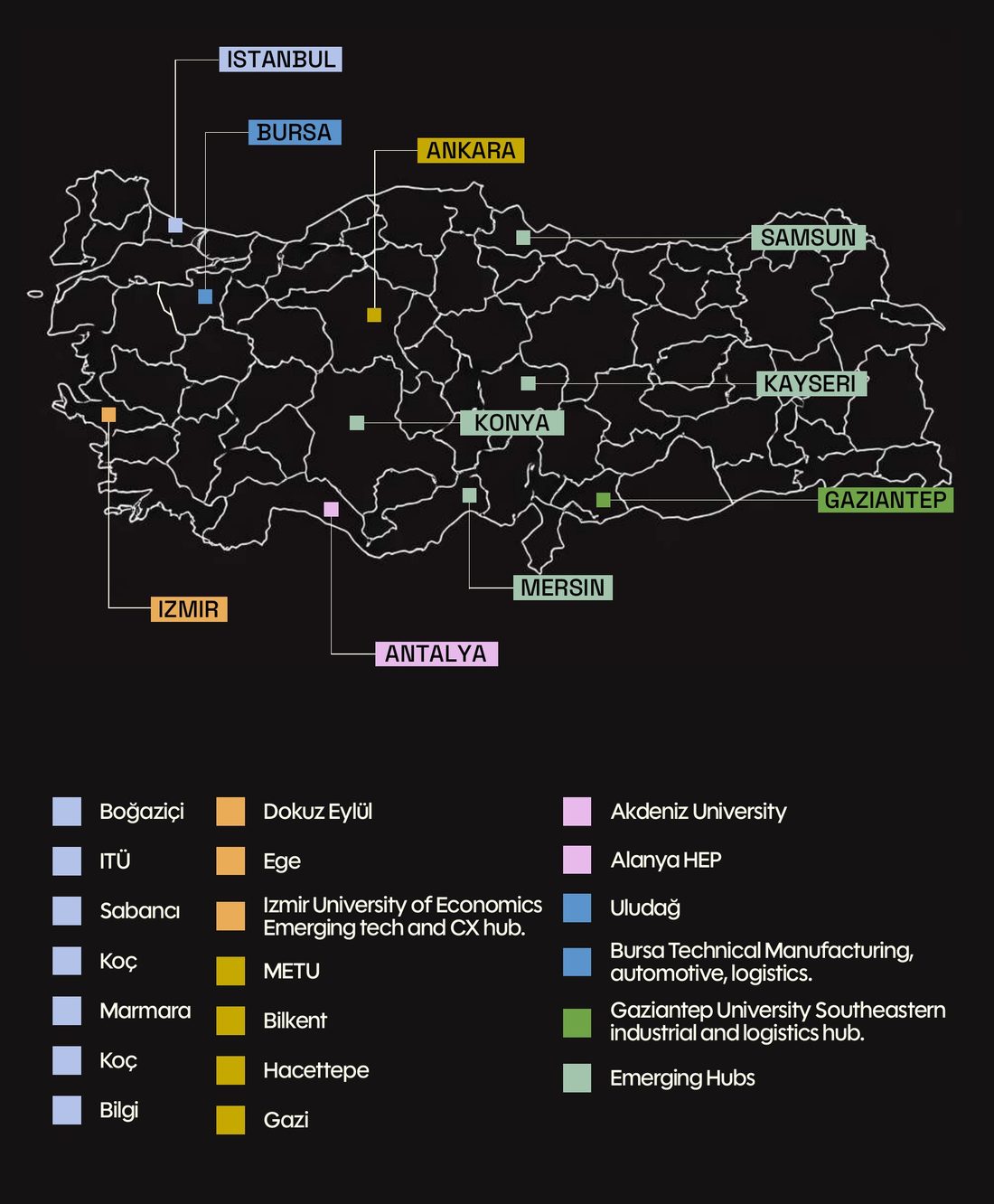
University density, tourism exposure, and digital access combine to create multilingual, high-volume talent pools well beyond Istanbul. Here's how the main hubs break down:
Why this matters operationally. Hiring strategy must reflect geography:
Yetenekler mevcut... asıl zorluk onları bulmak ve elde tutmak. ("The talent is there... the real challenge is finding them and keeping them.")
Job boards still matter, Instagram pulls massive reach, and LinkedIn is becoming more relevant, but the real hiring action happens on WhatsApp. With 88.6% of all Turkish internet users on WhatsApp, the single most popular app in the country (TurkStat ICT Survey, 2025), this isn't a niche behavior, it's the behavior. Candidates discover a job on a board or on Meta, but the moment they're genuinely interested, they shift everything to WhatsApp because it's faster and familiar. Within social, one channel leads:
"Instagram is more popular in Turkey than the other social networks."
— Işıl Özalp, Concentrix, regional talent lead for the Middle East and Türkiye
The distinction that matters operationally: job boards and Instagram are where you find candidates; WhatsApp is where you engage and convert them. In practice, almost every successful high-volume funnel in Turkey follows the same pattern: attract on social or job boards, then convert on WhatsApp.
What actually drives sourcing volume in Turkey. Community-driven sourcing plays a major role. Industry WhatsApp groups, language-based communities on Instagram, and informal referral networks consistently outperform formal channels for volume roles, especially for multilingual hiring. Turkish candidates trust peer recommendations deeply, and a single well-placed referral from within a community can produce more qualified applicants than a week of job board posting.
One nuance from the Istanbul dinner: most employers in the room use Instagram and TikTok for employer branding rather than hiring volume, and few could point to more than 5 to 10% of hires coming from social. The volume still arrives through job boards, referrals and WhatsApp; social earns its place when it is paired with a click-to-WhatsApp flow and measured on hires, not followers.
That reframes what job boards are actually for. They function as credibility and validation channels: most real candidate engagement happens elsewhere. They are not conversion engines, but signal channels where candidates expect to see your brand.
A verified WhatsApp Business number, a recognizable sender name, and a professional welcome message aren't optional extras. Turkish candidates distinguish sharply between a personal number and a verified business one; when branding is unclear, messages get ignored or flagged as spam.
Even on Meta campaigns, volume spikes only after candidates enter the WhatsApp chatbot. That's when automation takes over and the funnel becomes predictable. Put simply, most TA teams in Turkey think in terms of what each channel is actually for:
The channel mix creates awareness. WhatsApp creates hires.
Here's what a strong WhatsApp-first funnel looks like end to end:
"For the UK I get maybe ten applications for a position. For Saudi Arabia, 300. Turkey is in between, more than 100. The hiring manager stage is the same everywhere, and that is where I get stuck: getting available time slots takes a lot of time, it is not a good candidate experience, the candidate loses motivation, and we lose good talent."
— Regional talent acquisition partner, US medical device company, covering Türkiye, the Middle East and Europe (Istanbul dinner, April 2026)
Adayın bulunduğu yerde, kullandığı araçlarla iletişim kur. ("Reach the candidate where they are, with the tools they use.")
High-volume hiring in Turkey is a daily sprint, not just a workflow. Teams wake up knowing the candidates they sourced yesterday may already be gone, sourcing 200 candidates on Monday and struggling to re-engage half of them by Wednesday isn't personal, it's the market. Candidates switch opportunities easily and tend to choose whichever recruiter responds first, which makes responsiveness the real lever: if your first reply to a new application takes more than 15–30 minutes during business hours, you're likely losing candidates to teams that have already automated that step.
This creates a truth every TA leader in Turkey knows deeply: speed is survival. Not aggressive speed, but responsiveness. That quick WhatsApp reply, that immediate prescreen, that one-minute confirmation message. These small touchpoints make the difference between filling a class and losing a pipeline.
Many employers in Turkey now run fully remote hiring processes and only meet candidates on Day 1. This improves speed and volume, though early attrition can increase slightly when candidates haven't visited the workplace before starting. For most teams, overall cost per successful hire still improves. Remote hiring also dramatically expands access to Anatolian city talent and female candidates who face commuting barriers. The preference is regional, though, and TA leaders who run both ends of the country plan for it.
"If you go to the east part of Turkey, all the interviews are done face to face. This is what people prefer. In Istanbul, even remote interviews are preferred. It depends on the culture and how people feel comfortable."
— Işıl Özalp, Concentrix, regional talent lead for the Middle East and Türkiye
Asked when applications arrive, the room's answer was "mostly on Sundays, after breakfast", and almost nobody's process answered a candidate after 7 PM. Automated acknowledgement, prescreen and self-scheduling inside WhatsApp turn that gap into a head start: the candidate who applied at 11 AM on Sunday has an interview slot before anyone else has opened their inbox.
Messy data is normal here too. Three different spellings of one name, the same person under two phone numbers, no CV, no polished profile. What candidates do have is availability and ambition, and that's enough, if your funnel can help structure those raw inputs. Teams that rely on manual sorting end up buried; teams that use automation to capture, clean, and consolidate that data free up real time for actual conversations. Don't design your process around clean data. Design it to work well with messy data.
The same goes for tone: Turkish candidates respond to short questions, quick taps, voice notes, and clarity on salary and shifts, not long forms or stiff corporate messaging. A first message that feels bureaucratic loses them; one that feels human and clear keeps them moving.
The difference usually shows up inside the first three messages.
What loses candidates
What keeps them moving
Ghosting is a fact of the market, but it's not fixed. Almost every recruiter in Turkey has felt the sting: you schedule 12 interviews and 5 show up, or you confirm a candidate twice and they still change their mind the morning of the interview. Across Talkpush client operations in Turkey and comparable markets, a first-interview no-show rate below 25 to 30% is workable, 30 to 45% is common, and above 50% means the invitation, the slot or the hiring manager is broken.
A Day 1 absence rate above 10% is the real red flag, and it is rarely about the candidate's commitment; more often it reflects a gap between the offer and an actual human connection. In construction and plant hiring, no-shows often trace back to cash-in-hand gigs that pay the same week, which is why communicating the total package (transport, meals, SGK) beats quoting the base wage.
"Ghosting is a two-way problem."
— Managing director, global packaging manufacturer, Turkey (Istanbul dinner)
"Is ghosting our fault? Partially, yes. It is a structural problem of the hiring company."
— Operations leader, Concentrix Türkiye
Ghosting increases when the role isn't explained clearly, salary expectations are unclear, communication feels distant or transactional, or the process drags on. Ghosting falls when the job is sold properly, expectations are transparent, messages feel human, and reminders are timed well. In many cases ghosting isn't about commitment at all, it's about confidence: when candidates trust the recruiter and understand the opportunity, they show up.
Employers ghost too: a "we'll call you" with no call teaches candidates that your brand does not answer. Automated status updates and rejections close that loop at no recruiter cost, and the room asked whether the automation covers the employer side as well. It does: timed rules, status messages and automated rejections run whether or not a recruiter remembers.
Job-selling, not job-posting, is where the real conversion happens. Candidates want to know whether they'll grow, be respected, work in a professional environment, actually keep pace with inflation, get proper training, and have a realistic commute. These aren't "nice extras", they're the emotional anchors that convert candidates from curious to committed. Recruiters with strong show rates don't just screen candidates, they guide and reassure them and explain the opportunity with care. Candidates don't just choose a job. They choose the person who made them feel it was worth showing up.
Pro tip. Candidates often misinterpret job details because of the high volume of offers they receive daily, which leads to early attrition. One effective solution is deploying short AI-powered job explainer videos (tools like Synthesia work well here) covering shifts, salary, KPIs, training, and location expectations in the candidate's language. Short, consistent, and translatable to multiple languages simultaneously, so every candidate gets the same clear message. This reduces miscommunication, frees recruiter time, and improves early retention.
Tools matter, but timing matters more. Technology only works when it matches the speed of the market, and the tools that matter most aren't complex ones; they're the ones that remove friction at the exact moments candidates are most likely to disengage: replying the instant interest is highest, confirming interview details before doubt sets in, filtering unqualified profiles without slowing the recruiter down, and sending reminders at the moment candidates are most likely to forget. When timing aligns with candidate behavior, the entire funnel feels smoother. When it doesn't, even the best technology falls flat.
Sadece hız değil, netlik de başarının ölçüsüdür. ("Not just speed: clarity is also a measure of success.")
Demand for English, German, French, Arabic, Russian, and Spanish keeps rising across Turkish BPO and CX operations, but assessing those skills quickly and consistently is a persistent bottleneck. Recruiters working multilingual roles in Turkey will recognize the pain points: screening calls that run too long, inconsistent judgment between interviewers, candidates who sound confident over text but not on a call, assessments that stall the funnel for 24 to 72 hours, and no-shows that climb whenever an assessment step feels slow or unclear. Traditional assessments weren't built for WhatsApp-first candidates or for the pace of this market. Teams need a modern approach that is fast, mobile-friendly, objective, and able to scale.
One constraint the room put on the map: English fluency thins out fast beyond the city centres. Global manufacturers in Kocaeli and İzmit increasingly place support-centre, finance and HR roles at the plant rather than in an Istanbul office, and "it is much harder to find someone speaking English there, because talented people prefer to stay close to the city centre", as a former Randstad and Michael Page consultant put it. Three fixes work: source from city-centre universities and offer relocation or transport, allow hybrid for the support roles, and assess the language level up front so recruiters stop losing a week per candidate on phone screens.
This is why more high-volume teams in Turkey are shifting to automated, voice-based assessment. Talkpush's TalkScore evaluates pronunciation, fluency, grammar, vocabulary, comprehension, and active listening, then maps performance to CEFR-style tiers (A/B/C) that recruiters can filter on instantly. Inside the WhatsApp flow it triggers immediately and needs only 20–40 seconds of real voice to start scoring; the full assessment takes only a few minutes, and scores return within seconds. That keeps candidates moving forward and prevents the typical drop-off caused by waiting for a callback.
Scores sync automatically into the ATS or CRM, and the assessment mirrors a natural voice-note conversation rather than a formal exam, which matters in a market where many candidates are genuinely fluent but perform poorly under high-pressure test formats.
Three other things matter operationally. TalkScore is customizable for every job role, adapting to the communication style each one needs, whether that's customer service, sales, voice support, or multilingual queues. Assessments can mix question formats, including Listen and Repeat, Play Media, and Listen and Speak, which adds depth without making the experience feel heavier for candidates. And it only scores valid responses, which keeps the assessment fair, precise, and consistent for every candidate.
It also handles something specific to Turkey: candidates frequently switch fluidly between Turkish and their target language mid-sentence. That's comfort and context, not a proficiency gap, and a modern assessment needs to recognize that behavior rather than penalize it. TalkScore detects the shift and evaluates the target-language portions cleanly, producing a far more accurate read on real communication ability, especially for roles where agents move between languages constantly during a single interaction.
The questions themselves stay close to the job. A typical opener for a CX role is simply "How do you handle an unhappy customer?" (Memnuniyetsiz bir müşteriyle nasıl ilgilenirsiniz?), asked and answered by voice, in the candidate's own words.
Curious what a Turkish-language voice interview actually sounds like? Book a demo and we'll walk you through the AI Voice Interviewer live, including its multilingual assessment across English, German, Arabic, Russian, and more.
Most TA leaders in Turkey run a blend of internal recruiters, agencies, and referrals, with most core multilingual and CX hiring handled directly in-house and agencies typically reserved for niche skills, sudden volume spikes, or geographic expansion.
In these moments, agencies act like extra arms for your team, supporting volume without forcing you to increase permanent TA headcount.
The limitations are just as predictable: agency interactions tend to focus on screening rather than job-selling, which raises ghosting when candidates don't fully understand the role; quality varies significantly between vendors; and candidates in Turkey respond more strongly to hearing directly from the employer than from a third party. None of this makes agencies ineffective, it just means they work best paired with clear internal oversight and quality KPIs: candidate reachability, salary and shift alignment accuracy, show rates, 30–60 day retention, and duplicate tracking across submissions.
The most effective model in Turkey is a hybrid one: internal TA owns the WhatsApp-first funnel, prescreening logic, job-selling and expectation setting, ATS and data structure, language and voice assessment, and hiring manager alignment, while agencies support at peak volume, for niche languages, and during early-stage expansion.
As companies scale, strong in-house TA becomes the engine that keeps hiring predictable, since internal recruiters understand the actual day-to-day of the role, the culture, and which profiles thrive on which accounts, in a way no external partner fully can. That clarity leads to better alignment and stronger early retention, and internal teams can also build talent pools, maintain cleaner data, and use automation tools more deeply, since they control the process end to end.
Tools strengthen both sides. Whether hiring is handled internally or supported by agencies, automation, consistent workflows, and fast assessments improve results for everyone. Clean prescreens, TalkScore assessments, and ATS syncing help both sides produce more predictable outcomes. When tools create structure, agency pipelines and in-house pipelines both become easier to manage.
This is the whole guide brought down to a set of practical actions, usable as a weekly alignment tool with your TA team or as a quick audit of your current funnel.
A simple KPI panel anchors the weekly huddle in any high-volume Turkish market:
These numbers surface funnel friction faster than any narrative report.
No complexity, no delays, just a clean, mobile-first path.
Speed and clarity, in that order. Get your first reply to a new application out inside 15–30 minutes during business hours, state the salary range and shift pattern in the first message rather than after a form, and send the interview reminder the night before rather than the morning of. A first-interview no-show rate of 25–30% is workable in Turkey and 30–45% is common, but a Day 1 absence rate above 10% signals that the role wasn't sold properly, not that the market is broken.
Kariyer.net is the largest and oldest platform, with close to 13 million monthly visits and over 28 million CVs, and it's essential for brand visibility and mid-career hiring. Eleman.net has better alignment with mobile-first frontline workers outside Istanbul, and İŞKUR is useful for smaller cities and government incentive programmes. Yenibiris.com and SecretCV work as secondary channels. None of them are conversion engines, though: boards act as credibility and validation channels, and the actual conversion happens on WhatsApp.
Because 88.6% of all Turkish internet users are on WhatsApp, making it the single most popular app in the country (TurkStat ICT Survey, 2025). Turkey also has the highest daily smartphone use in Europe, at 4 hours and 4 minutes, with 96.9% of internet users reaching the web via mobile. Candidates may discover a role on a board or on Meta, but they move the real conversation to WhatsApp. One caveat: it only works from a verified WhatsApp Business number with a recognizable sender name, or messages get treated as spam.
By voice. TalkScore evaluates pronunciation, fluency, grammar, vocabulary, comprehension, and active listening, then maps the result to CEFR-style A/B/C tiers recruiters can filter on. Inside the WhatsApp flow it triggers instantly and needs only 20–40 seconds of real voice to start scoring; the full assessment takes a few minutes and scores return within seconds. It mixes formats such as Listen and Repeat, Play Media, and Listen and Speak, only scores valid responses, and recognizes Turkish-to-target-language code-switching instead of penalizing it.
Sharply. The minimum wage rose 30% in 2025 and a further 27% in 2026, with over a third of the workforce earning at or near that level, and labour costs across trade and services surged 44.3% year-on-year in Q2 2025 (TurkStat). The practical consequence is wage compression: a recruiter with two years of tenure can end up earning almost what a new hire does. Candidates compare offers constantly and expect salary clarity upfront, so managing compensation bands proactively rather than reactively is one of the highest-leverage moves available to a TA leader here.
Ankara for tech, shared services, and government-adjacent roles; Izmir as an emerging tech and CX hub with a quality-of-life pull; Antalya for tourism-built German and Russian fluency and hospitality or multilingual CX; Bursa for manufacturing, automotive, and logistics; and Gaziantep for southeastern industrial and logistics work at lower salary pressure. Konya, Kayseri, Samsun, and Mersin are emerging fast. Commute distance directly affects show rates, so remote-eligible roles are what unlock Anatolian talent at scale.
Turkey's high-volume hiring market is entering a defining phase. From customer experience and contact centres to retail, QSR, logistics, manufacturing, and field operations, the talent is here and the demand is growing. The teams who adapt their hiring operations now will be the ones who benefit most from the 2025–2026 boom.
Talkpush is actively building out Turkey-specific resources: local hiring insights, WhatsApp funnel best practices, multilingual benchmarks, event invitations in Istanbul and beyond, and case studies from teams that have scaled hiring in Turkey without adding headcount. We're also running a Turkey TA Spotlight and newsletter, with short interviews and stories from recruiters, TA managers, and operations leaders who are shaping Turkey's hiring landscape. If you'd like to take part, we'd love to hear from you; otherwise we'll be sharing those stories through our blog and email newsletter.
To get Turkey-specific updates, sign up at the bottom of our homepage, and you'll receive practical insights and local event news, no generic marketing emails. And if you're running high-volume TA in Turkey and want to compare notes, help shape what we build next, or just talk through your current funnel, reach out directly at Turkey@talkpush.com.
The TA Leadership Dinner on 15 April 2026 brought thirteen talent leaders from retail, manufacturing, logistics, telecom, medical devices, BPO and staffing into one room, with a live AI interview in Turkish as the centrepiece. What they confirmed, corrected and added:
Piyasa hızla değişiyor — hazır mısın? ("The market is moving fast — are you ready?") Small, consistent structural changes, shifting to WhatsApp-first, clarifying salary ranges earlier, tightening knockout rules, adding structured language assessment, or reducing manual data work by even 10–20%, tend to matter more at scale than any single big rebuild. That reclaimed time can be reinvested where it really counts: job-selling, relationship-building, and smarter decision-making. You don't have to fix the whole funnel at once. Start with one piece, measure the impact, then move to the next.
You know your candidates, your teams, and your market better than anyone. Our goal is to give you tools and structure that make your work easier, clearer, and more scalable, while keeping the human side of recruiting front and centre. Thank you for reading, and for the work you're doing to build Turkey's next generation of high-volume recruitment teams.
Sesini duyurmak istiyorsan, Türkiye'nin TA topluluğuna katıl. ("If you want your voice heard, join Turkey's TA community.")
Ready to go deeper? Talk to us about your Turkish recruitment funnel.
Bloomberg. (2025, December 23). Turkey raises minimum wage by 27% in line with expectations. bloomberg.com
DataReportal. (2025). Digital 2025: Turkey. Kepios. datareportal.com
Deep Market Insights. (2026). Turkey business process outsourcing (BPO) market size, share & growth analysis 2026–2033. deepmarketinsights.com
Gini Talent. (2025). Entry-level workers Turkey salary guide 2025. ginitalent.com
International Labour Organization. (2025). ILOSTAT labour force statistics: Turkey 2025. ilostat.ilo.org
P.A. Turkey. (2025, August 22). Turkey's labor costs jump 44% in Q2 2025 as industry struggles. paturkey.com
Talkpush. (2026, April 15). TA Leadership Dinner Istanbul: recorded roundtable with talent leaders from LC Waikiki, Arkas Holding, ALPLA, FLO, Align Technology, Türk Telekom, Adecco, Randstad and Concentrix. Internal transcript.
Talkpush. (2026). Large employers in Turkey: headcount and store counts compiled from company annual reports and investor presentations, 2025. Internal research.
Talkpush. (2026). Internal knowledge, documentation, and industry experience. talkpush.com
TechRT / DemandSage. (2026). Smartphone usage statistics 2026: Powerful insights and trends. techrt.com
Top Talent in Turkey. (2025). Turkey's 2025 minimum wage rise: What to know. top-talent-in-turkey.com
Turkonomics. (2025, May 19). Turkey's labor market crisis: Unemployment challenges in a growing economy. turkonomics.net
Turkish Minute. (2026, March 25). Turkey's broadly defined unemployment rose to 29.7 percent in 2025: TurkStat. turkishminute.com
Turkish Statistical Institute (TurkStat). (2025). ICT usage in households and by individuals survey 2025. tuik.gov.tr
Turkish Statistical Institute (TurkStat). (2026, March 25). Labour Force Statistics 2025: unemployment 8.3%, participation 53.5% (men 71.3%, women 36.2%). tuik.gov.tr
Kariyer.net. (2024, June). Corporate press releases: 28 million+ CVs, 600,000+ member companies, 1.4 million placements a year. kariyer.net
Workello. (2025). Guide to the best job boards in Turkey: Top 9 picks. workello.com



Talkpush powers high-volume
hiring in emerging markets.