September 4, 2026
10 min read
High-Volume Hiring in Egypt: The 2026 Guide for TA Teams




September 4, 2026
10 min read
Egypt's high-volume hiring market is entering a defining moment, shaped by scale, speed, and a new kind of candidate behavior. Demand for multilingual talent has accelerated, inflation has reshaped compensation expectations, and global employers have intensified their hiring across Cairo, Alexandria, and emerging talent hubs across the country.
But the real story isn't just growth. It's how quickly the talent market has changed underneath it. Candidates today are mobile-first, WhatsApp-first, and often completely CV-free. It's not that talent isn't out there; it's that the traditional ways of reaching, screening, and engaging candidates no longer keep up with how they actually behave. Recruiters are frequently working with nothing more than a name and a phone number, which makes early screening messy, repetitive, and increasingly difficult to scale.
And even with the right candidates in the pipeline, the competition has become fierce. New entrants frequently use aggressive salary strategies to attract talent quickly, while established players must rely on stronger employer branding, better candidate journeys, and faster hiring cycles to stay ahead. This is where many teams start to feel the pressure: more volume, more languages, more expectations… and fewer hours in the day.
And yet this is also a moment of real opportunity. The Egyptian market is now more ready than ever for automation, voice-based assessment, and mobile-driven recruitment flows that meet candidates where they already are, in the tools and apps they use every day. What used to be "nice to have" has become the only scalable way to manage daily volume while keeping the human side of recruiting intact.
Here's the short version. Egypt has a labour force of more than 32 million, over 96 million people online (DataReportal, 2025), and a BPO sector targeting 500,000 jobs by 2026 (ITIDA). This guide covers what that means operationally: where volume actually comes from, how to build a WhatsApp-first funnel, how to reduce a 30% early-stage no-show rate, and how to validate multilingual ability in seconds instead of days.
How this guide was shaped. It was refined through direct conversations with TA leaders in Egypt. In January 2026, we spent time on the ground in Cairo learning what works, and what doesn't, in real Egyptian high-volume hiring environments. We came to listen, pressure-test assumptions, and this guide was updated to reflect those insights.
Who is this for? Anyone working in high-volume talent acquisition who hires in Egypt across industries like BPO/CX, Retail, QSR/Foodservice, Utilities, Telecom, Construction, Logistics, Hospitality, and Tourism. The information within applies to all high-volume hiring industries. We work with both Egypt-based employers and global high-volume brands expanding into Egypt, so the patterns in this guide reflect what we've seen across multiple countries, adapted to the reality in Egypt.
Inside, you'll find a practical, Egypt-specific playbook for running high-volume talent acquisition: where to find qualified candidates, how to build a WhatsApp-first funnel, how to reduce no-shows, how to screen more effectively, and how to introduce smart language assessment without slowing your team down. You'll find the real "how" behind Egypt's high-volume hiring. Think of this as the operational handbook that sits next to your ATS, the one that explains the "why" behind what's happening in Egypt today and gives you the "how" to navigate it. Whether you're scaling a new team, hiring multilingual agents for a new account, or simply looking to improve your candidate funnel conversions, it's designed to help you make faster, clearer decisions with more confidence. Here's what's actually shaping high-volume hiring in Egypt right now, and what to do about it.
Egypt has one of the youngest and most dynamic workforces in the region. With a labour force of more than 32 million people and unemployment down to roughly 6–7%, the country has a large, active pool of talent, but also rising competition for it. The BPO industry alone employs roughly 300,000 people, and Egypt's national strategy, ITIDA's Digital Egypt Vision for Offshoring Industry 2022–2026, aims to grow that to 500,000 by 2026 while nearly doubling digital offshoring exports to close to $9 billion (Ahram Online). Egypt's female workforce is also expanding year over year, widening the available talent pool for high-volume roles just as demand rises across retail, QSR, logistics, telecom, utilities, and hospitality. It's an enormous opportunity, but also a rapidly shifting one.
The talent is there. The challenge is everything around it.
Egyptians are also online and on mobile at a scale that reshapes how hiring has to work: more than 96 million people online, 116 million mobile connections, roughly 3 hours a day spent on mobile platforms, and over 50 million people with a social media identity (DataReportal, 2025). Messaging apps dominate candidate behavior as a result. Cairo and Alexandria still anchor volume, but digital access is making talent from Upper Egypt, the Delta region, and emerging cities increasingly reachable.
Insight from the Cairo event — why Egypt produces multilingual talent. Tourism, accessible university education, and strong language departments have shaped Egypt's talent market over decades. Many candidates build fluency through tourism and customer-facing work long before entering formal employment, encouraging young Egyptians to learn German, French, and Spanish. This helps make Egypt especially strong for high-volume multilingual roles.
Here are the realities TA teams need to plan around to hire at scale:
A young, urban, mobile-first workforce. Egypt isn't just theoretically mobile-first, it's lived behavior. With more than 96 million people online and over 50 million social media identities (DataReportal, 2025), messaging apps aren't a channel among many, they're the default way Egyptians communicate. Cairo and Alexandria still anchor hiring volume, but digital access is opening up talent in the Delta region, Upper Egypt, and Red Sea cities that used to be out of reach. This generation wants speed, transparency, and communication in the channels they use and trust. They expect the same from employers.
Limited and inconsistent applicant data. Most frontline candidates enter the funnel with no CV, inconsistent name spellings, phone numbers that change, and minimal written documentation. That's not a sign of low quality, it's a market characteristic. At a market level, it means TA teams cannot rely on polished profiles or resumes; most real screening begins through conversation after first contact, typically on WhatsApp. TA teams that expect polished profiles get buried; teams that build conversational screening keep moving.
Salary pressure and inflation-driven expectations. Inflation has forced repeated pay adjustments; some BPO employers have made four to five salary adjustments in two years just to stay competitive (Hany Zaher). New entrants often launch with above-market "best seller" pay to build a foothold fast, which means candidates compare offers constantly, negotiate earlier, and expect salary clarity upfront. Transparent communication around compensation has become essential to reduce misalignment.
Uneven employer brand recognition. Many frontline candidates in Egypt don't recognize global outsourcing or CX brands, even well-known international names. Without a strong brand story, teams see more uncertainty, weaker commitment, more ghosting, and lower show rates. With one, they see more trust, better engagement, and stronger show-ups. Job-selling matters more than job-posting here; the story has to be told, not assumed.
Real but contested multilingual talent. Egypt's multilingual workforce is a core reason the country is a fast-growing offshoring destination. Demand for English, German, French, Spanish, and Gulf Arabic keeps rising, and as digital offshoring exports are projected to triple under Egypt's national strategy (ITIDA), multilingual pipelines are getting tighter and more competitive. The candidates aren't hard to find; validating their language ability quickly, at scale, is the actual bottleneck. Automation isn't a luxury here, it's how you survive the speed of the queue, and smarter assessment and automation become strategic advantages.
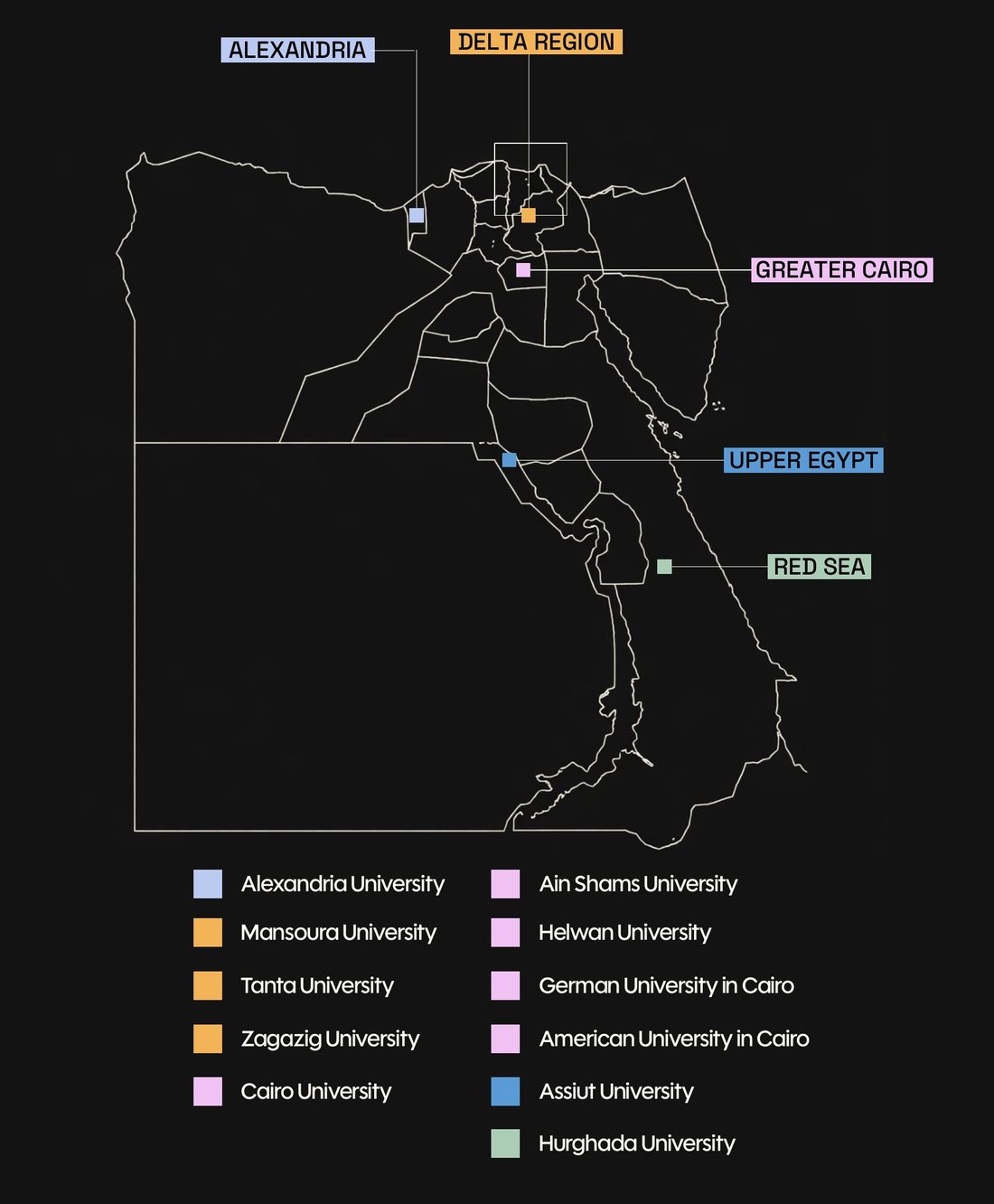
Regional sourcing patterns matter more than ever. Egypt's talent market is no longer Cairo-first. Strong pipelines now extend into Alexandria, the Delta region (Mansoura, Tanta, Zagazig), Upper Egypt (Assiut), and Red Sea tourism cities like Hurghada, where decades of tourism have built genuine German and Russian fluency. Understanding commuting distance, transportation realities, and local salary expectations is essential when screening candidates, especially for on-site roles. Four things follow directly: commute distance impacts show rates; salary expectations vary by region; remote hiring expands access to Upper Egypt; and multilingual talent often clusters around tourism-heavy areas and language faculties. Hiring strategy has to reflect geography.
A university ecosystem built for multilingual, high-volume roles. Egypt's talent is geographically distributed. Greater Cairo remains the primary hub for BPO, shared services, telecom, and multinational operations, anchored by Cairo University, Ain Shams, Helwan, the German University in Cairo, and the American University in Cairo. Alexandria University feeds multilingual and customer-experience roles, while Mansoura, Tanta, and Zagazig universities are emerging as high-volume sourcing hubs with lower salary pressure and strong graduate output. Assiut University anchors growing remote and hybrid talent pools in Upper Egypt, and Hurghada University sits at the center of the Red Sea's tourism-driven multilingual fluency, especially German and Russian. University density, tourism exposure, and digital access combine to create multilingual and high-volume talent pools across the country. For employers hiring at scale, regional strategy isn't optional anymore, it's operational leverage.
Candidates expect clarity, humanity, and quick movement. Across every demographic, candidates consistently ask for clear salary ranges, transparent shift and location details, simple application flows, faster responses, and respectful follow-up. In Egypt's high-volume environment, candidates don't wait. When expectations are unclear, they move on; when communication is quick, clean, and human, conversions rise.
Pro tip (via Hany Zaher). Candidates often misinterpret job details due to high daily offer volume, leading to early attrition. One solution is to deploy AI-powered videos for clear job expectations (e.g., Synthesia). Explain shifts, salary, KPIs, training, and other expectations, and the videos can be translated into multiple languages at the same time. They're short, localized, accurate, and consistent, ensuring every candidate receives the same message. This reduces miscommunication, frees recruiter time, and improves candidate alignment and early retention.
Job boards still matter, Meta pulls massive reach, and LinkedIn is becoming more relevant for niche and leadership roles, but ask any recruiter working high-volume roles in Egypt and they'll tell you the same thing: the real hiring action happens on WhatsApp.
Candidates don't always follow a linear path. They may discover a job through Meta, Wuzzuf, Forasna, LinkedIn, or a friend, but the moment they're genuinely interested, they shift everything to WhatsApp because it's faster and familiar, and it reflects how Egyptians already communicate every day. Recruiters describe it simply: "I posted everywhere, but every real conversation started on WhatsApp. That's where hiring actually lives."
The distinction that matters operationally: Meta (Facebook and Instagram) and job boards are where you find candidates; WhatsApp is where you engage and convert them. In practice, almost every successful high-volume funnel in Egypt follows the same pattern: attract on social or job boards, then convert on WhatsApp. That behavior shapes every effective sourcing strategy — create awareness across channels, then pull candidates into WhatsApp as quickly as possible, where screening, job-selling, and scheduling all become dramatically easier. This is where volume accelerates, automated screening does the real work, and WhatsApp excels.
Insight from the Cairo event — WhatsApp only works when it's clearly official. Candidates distinguish sharply between personal WhatsApp messages and verified employer numbers. When branding is unclear, messages are ignored or treated as spam. Trust is a prerequisite for WhatsApp-based hiring at scale.
Even on Meta campaigns, volume spikes only after candidates enter the WhatsApp chatbot. That's when automation takes over and the funnel becomes predictable. This is why most TA teams in Egypt think in terms of a channel mix rather than a single source:
Job boardsVisibility.Meta adsScale and reach.WhatsAppConversion and qualification.Freelance recruitersCommunity local sourcing.ReferralsHigh-trust, high-show-rate candidates.Direct WhatsApp sourcingInbound leads without forms.
The channel mix creates awareness. WhatsApp creates hires.
Insight from the Cairo event — what actually drives sourcing volume in Egypt. Community-driven sourcing plays a major role. Language-based Facebook groups and informal referral networks consistently outperform formal channels for volume roles, especially for multilingual hiring.
Before going deeper into funnels and automation, it's worth grounding what job boards are actually for. Job boards function as credibility and validation channels; most real candidate engagement happens elsewhere. They are not conversion engines, but signal channels where candidates expect to see your brand. We also heard that some job boards are seen as low quality contributors. LinkedIn is used most often in Egypt and Wuzzuf is not; the others vary.
LinkedInEssential for professional roles, niche languages, and leadership hiring. Growing quickly, but still secondary to Meta for pure frontline volume.ForasnaLarge volume and wide geographic reach, and effective for retail, logistics, F&B, and entry-level customer service. Best alignment for mobile-first, blue-collar and frontline service workers.BAYT.comA Middle East talent hub used across Egypt and the Gulf. Useful for bilingual Arabic/English roles or positions tied to regional mobility.Facebook / Meta adsNot a traditional job board, but the largest source of affordable leads in Egypt. Reaches younger demographics, frontline and multilingual talent faster than any job board, and becomes exceptionally powerful paired with WhatsApp automation.WuzzufDeclining in relevance. Fewer TA teams report using it, candidate quality has reportedly dropped, and most participants at a recent Cairo TA gathering said they now rely on LinkedIn for active sourcing instead.
Most employers treat job boards as signal channels, but the real funnel lives elsewhere: job boards attract, Meta scales, WhatsApp converts.
Job boards vs. social ads: a quick cost perspective (CPL). Across global high-volume markets, Meta ads consistently produce cheaper leads than job boards, and the same pattern is emerging in Egypt: job boards deliver higher intent but at higher cost, while WhatsApp filters at scale to lower cost per hire. Automation is what makes this mix sustainable. With a WhatsApp prescreening bot, even low-cost, low-intent leads can become qualified applicants. We plan to publish Egypt-specific CPL and CPH benchmarks once we complete ongoing data collection with local employers.
Here's what a strong WhatsApp-first funnel looks like end to end: the candidate clicks an ad or job post and lands directly in WhatsApp, no forms or passwords; receives a short, friendly welcome message in Arabic or English; answers simple prescreen questions with quick taps (name, location, availability, language level, expected salary); optionally leaves a short voice-note introduction, AI Voice Interviewer-ready, because as one recruiter put it, "a 20-second voice note tells me more than a CV ever could"; hits automated knockout rules on distance, shift fit, and salary alignment; qualified candidates get instant scheduling; a recruiter is assigned with automated WhatsApp reminders; and everything syncs to the ATS, no screenshots, no chaos.
"In Egypt, it's not about doubling candidates, it's about checking how serious they are. Many people apply without real intent. The approach matters more than volume."
— Iyad Hafez, CEO, Staff Arabia
High-volume hiring in Egypt is a daily sprint, not just a workflow. Teams wake up knowing the candidates they sourced yesterday may already be gone. The market moves fast, expectations shift quickly, and recruiters are expected to stay steady in the middle of it all. If you've worked in this environment, you know the feeling: the constant pressure to keep up, to follow up, to get back to candidates before they disappear into someone else's funnel.
Insight from the Cairo event — remote hiring works, with tradeoffs. Many employers now run fully remote hiring processes in Egypt and only meet candidates on Day 1. This improves speed and volume, though early attrition can increase slightly. For many teams, overall cost per successful hire still improves.
Volume moves fast and disappears even faster. You might source 200 candidates on Monday, feeling confident, only to struggle to engage half of them in the following days. It isn't personal, it's the market. Candidates switch opportunities easily, explore several at once, and tend to choose whichever recruiter responds first. Which creates a truth every TA leader in Egypt knows deeply: speed is survival. Not aggressive speed, but responsiveness — that quick WhatsApp reply, that immediate prescreen, that one-minute confirmation message. These small touchpoints make the difference between filling a class and losing a pipeline.
Messy data is normal here too. Three different spellings of one name, two identical phone numbers under different profiles, no CV, no polished LinkedIn, no neatly typed profile. What candidates do have is availability and ambition, and that's enough if your funnel can help structure those raw inputs. Teams that rely on manual sorting end up buried; teams that use automation to capture, clean, and consolidate that data create breathing room for real conversations.
The same goes for tone: Egyptian candidates respond to short questions, quick taps, voice notes, and clarity on salary and shifts, not long forms or stiff corporate messaging. A first message that reads like paperwork loses them; one that feels human and clear keeps them moving. TA teams with the best completion rates tend to use WhatsApp-first flows that sound friendly and familiar, not robotic or corporate. Simplicity creates trust, and trust keeps candidates moving.
What loses candidatesWhat keeps them movingRecruiter: "Hello. Please complete this form. Thank you!"Recruiter: "Hi Ahmed 👋 quick question — are you open to a morning shift?"Candidate: "What is the salary?"Candidate: "Yes 👍"Recruiter: "It depends. Fill the form first."Recruiter: "Great. Salary is 8k–10k + bonus. Interview tomorrow?"Candidate: "…."Candidate: "Sounds good!"Recruiter: "Are you still interested?"Recruiter: "Perfect — I'll send a reminder 🙌"
Ghosting is a fact of the market, but it's not fixed. Almost every recruiter in Egypt has felt the sting: you schedule 12 interviews and 5 show up, or you confirm a candidate twice and they still change their mind on the morning of the interview. A 30% no-show rate during early stages is normal in the BPO sector; a Day 1 training absence rate above 10% is the real red flag, and it's rarely about the candidate's commitment. More often it reflects a gap between the offer letter and an actual human connection.
"In the BPO sector, a 30% no-show rate during early stages is a market reality, but a Day 1 Training absence exceeding 10% is a red flag. When candidates fail to show up for Day 1, it's rarely a market issue; it's a failure to bridge the gap between an offer letter and a human connection."
— Hany Zaher, former Concentrix Talent Acquisition Sr. Manager
Ghosting rises when the role isn't explained clearly, salary expectations are vague, communication feels distant or transactional, or the process drags on. It falls when the job is sold properly, expectations are transparent, messages feel human, and reminders are timed well. In many cases ghosting isn't about commitment, it's about confidence: when candidates trust the recruiter and understand the opportunity, including the benefits, they show up.
Job-selling, not job-posting, is where the real conversion happens. A well-crafted job post rarely wins on its own; what works is how the recruiter tells the story. Candidates want to know whether they'll grow, whether they'll feel respected, whether the environment will be professional, whether the salary will change, and whether they'll get training. These aren't nice extras, they're the emotional anchors that convert candidates from curious to committed. Recruiters with strong show rates don't just screen candidates, they guide them, reassure them, and explain the opportunity with care.
Candidates don't just choose a job; they choose the person who made them feel it was worth showing up. This human connection is one of Egypt's biggest recruiting advantages, and one of the easiest to lose when processes get rushed or overly automated.
Tools matter, but timing matters more. Technology only works when it matches the speed of the market. Tools don't need to be complex, they need to remove friction in the moments that matter: replying immediately when interest is highest, confirming interview details before doubt sets in, filtering unqualified profiles without slowing the recruiter down, and sending reminders at the exact time candidates are most likely to forget. When timing aligns with candidate behavior, the entire funnel feels smoother. When it doesn't, even the best tech falls flat.
That combination, WhatsApp-first engagement plus disciplined automation, is exactly what let TaskUs scale its Egypt hiring from 500 to 1,000 hires in 30 days without adding a single recruiter. See how in the full case study.
Demand for English, German, French, Spanish, and Gulf Arabic keeps rising across Egyptian BPO and CX operations, but assessing those skills quickly and consistently is a persistent bottleneck. Recruiters working multilingual roles in Egypt will recognize the pain points: screening calls that run too long, inconsistent judgment between interviewers, candidates who sound confident over text but not on a call, assessments that stall the funnel for 24 to 72 hours, and no-shows that climb whenever an assessment step feels slow or unclear.
"Egypt can deliver more high-volume multilingual talent per month than many European countries. The bottleneck isn't sourcing, it's screening languages fast enough."
— Jill Fitzpatrick, Global BPO Leader
Traditional assessments weren't built for WhatsApp-first candidates or for the pace of Egypt's market. Traditional screening gives depth but not speed, and TA teams now need tools that work smoothly on WhatsApp, Messenger, or mobile web; provide an objective read on English and other languages; tier candidates automatically (A/B/C or CEFR-style); reduce recruiter time spent on phone screens; offer a consistent scoring approach across the team; and keep momentum high so candidates don't drop off.
This is why more high-volume teams in Egypt are shifting to automated, voice-based assessment. Talkpush's TalkScore evaluates pronunciation, fluency, grammar, vocabulary, comprehension, and active listening, then maps performance to CEFR-style tiers (A/B/C) that recruiters can filter on instantly. The full assessment takes only a few minutes, and scores return within seconds, which keeps candidates moving and prevents the typical drop-off caused by waiting for a callback. Scores sync automatically into the ATS or CRM, reducing manual sorting, note-taking, and data entry. And because the experience mirrors a natural voice-note conversation rather than a formal exam, it helps candidates show their true communication ability.
Three things make it work operationally. It's customizable for every job role: TalkScore adapts to the communication style needed for each role, whether that's customer service, sales, voice support, or multilingual queues. It uses rich question formats for deeper insights: you can mix Listen and Repeat, Play Media, and Listen and Speak, which adds depth without making the assessment feel heavier for candidates. And it only scores valid responses, which keeps the assessment fair, precise, and consistent for every candidate.
In high-volume settings, this is the workflow that creates the most impact: the candidate enters the WhatsApp flow and chooses a language; a short prescreen clarifies basics like availability, salary, and location; TalkScore triggers instantly, capturing 20–40 seconds of real voice; the score appears immediately inside the ATS in CEFR-style A/B/C tiers; only qualified candidates move to scheduling; and recruiters spend more time on job-selling instead of filtering. The right profile, not every profile.
It also handles something specific to Egypt: candidates frequently switch fluidly between Arabic and English mid-sentence. That's comfort and context, not a proficiency gap, and a modern assessment needs to recognize that behavior rather than penalize it. TalkScore detects the shift and evaluates the target-language portions cleanly, producing a far more accurate read on real communication ability, especially for roles where agents move between languages constantly during a single interaction.
We've also created a new AI Voice Interviewer that uses an Egyptian Arabic accent. A typical prompt looks like this: "How do you handle an unhappy customer?" — إزاي بتتعامل مع عميل مش راضي؟ Candidates answer by speaking rather than typing. Let us know what you think and if we got the accent right.
Curious what an Egyptian-Arabic voice interview actually sounds like? Book a demo and we'll walk you through the AI Voice Interviewer live, and show you where voice-based screening and TalkScore could fit into your current flow.
Egypt's high-volume hiring market moves quickly, and some TA leaders rely on a combination of internal recruiters, agencies, and referrals, with most core multilingual hiring handled directly in-house and agencies typically reserved for niche skills or sudden volume spikes. Agencies add the most value on short-term volume boosts (new account launches, seasonal hiring, sudden headcount increases) where speed matters more than perfect alignment; hard-to-source languages like German, French, Spanish, and Gulf dialects where specialist networks already exist; and regional pipelines in Delta cities such as Mansoura, Tanta, and Mahalla, Alexandria, and parts of Upper Egypt, where a local partner can move faster than an internal team starting from zero. In those moments, agencies act like "extra arms" for your team, supporting volume without forcing you to increase permanent TA headcount.
The limitations are just as predictable: agency interactions tend to focus on screening rather than job-selling, which raises ghosting when candidates don't fully understand the role; quality varies significantly between vendors, with some delivering polished pipelines and others submitting mismatched candidates, unclear salary alignment, or duplicate profiles; and candidates in Egypt respond more strongly to hearing directly from the employer than from a third party. None of this makes agencies ineffective, it just means they work best paired with clear internal oversight and quality KPIs: candidate reachability, salary and shift alignment accuracy, show rates, 30–60 day retention, and duplicate tracking across submissions. With the right KPIs, agencies stop feeling like random volume and start behaving like extensions of your internal team, and ongoing calibration and communication matter just as much.
As companies scale, strong in-house TA becomes the engine that keeps hiring predictable. Internal recruiters understand the real day-to-day of the role, the company culture and career paths, what candidates usually ask or worry about, and which profiles thrive in specific accounts or teams. That clarity leads to better alignment and stronger early retention. Internal teams can also build talent pools, maintain cleaner data, and use automation tools more deeply, since they control the process end to end.
The most effective model in Egypt is a hybrid one: internal TA owns the WhatsApp-first funnel, prescreening logic, job-selling and expectation setting, ATS and data structure, language and voice assessment, and hiring manager alignment, while agencies support at peak volume, for niche languages, for geo-specific sourcing, and during early-stage regional expansion. This gives internal teams the consistency they need while keeping the flexibility Egypt's fast-moving market requires.
Tools strengthen both sides. Whether hiring is internal or supported by agencies, automation, consistent workflows, and fast assessments improve results for everyone. Clean prescreens, TalkScore assessments, and ATS syncing help both teams produce more predictable outcomes. When tools create structure, both agency pipelines and in-house pipelines become easier to manage.
A simple KPI panel anchors the weekly TA huddle in any high-volume Egyptian market: WhatsApp completion rate, time from application to first response, prescreen-to-qualified ratio, TalkScore completion rate for language roles, interview show rate, offer acceptance rate, and 30-day retention. These numbers surface funnel friction faster than any narrative report.
Weekly, the highest-leverage actions are reviewing the WhatsApp flow for unnecessary steps, checking that time from apply to first message stays low, confirming salary range and shift details are communicated upfront, auditing knockout rules for accuracy and fairness, tracking daily show rates and sending reminders, and keeping all candidate data in one system.
Monthly, teams should reassess sourcing channels by conversion, update prescreen questions to match market reality, recalibrate language requirements per role and per client, review pipelines and reset KPIs as needed, and identify automation opportunities.
Quarterly, it's worth comparing hiring velocity to market trends, revisiting compensation benchmarks and messaging, setting targets for language-level distribution (A/B/C), assessing team bandwidth and where automation can scale further, reviewing early retention (0–30 days) and attrition drivers, and identifying which roles are best suited for TalkScore or voice assessment.
The ideal candidate journey, in eight steps: sees a job ad, clicks through to WhatsApp, receives a welcome message, completes a short prescreen, takes a TalkScore or voice assessment if the role requires one, gets an interview link instantly, receives reminders, and attends the interview through to offer. No complexity, no delays, just a clean, mobile-first path.
Think of it as a mix with different jobs: job boards attract, Meta scales, WhatsApp converts. Job boards act as credibility and signal channels rather than conversion engines, Meta ads are the largest source of affordable leads, and WhatsApp is where qualification and conversion happen. Freelance recruiters, referrals, and direct WhatsApp sourcing round out the mix, and language-based Facebook groups consistently outperform formal channels for volume roles.
A candidate can click an ad, land in WhatsApp with no form or password, answer prescreen questions with quick taps, and hit automated knockout rules on distance, shift fit, and salary alignment in a single session. If the role needs a language check, a TalkScore assessment triggers instantly on 20–40 seconds of real voice; the full assessment takes only a few minutes and scores return within seconds. Qualified candidates get instant scheduling from there.
Yes, and it's widely adopted. Many employers now run fully remote hiring processes and only meet candidates on Day 1. That improves speed and volume, though early attrition can increase slightly. For many teams, overall cost per successful hire still improves, and remote hiring meaningfully expands access to talent in Upper Egypt.
Start by calibrating expectations: a 30% no-show rate during early stages is a market reality in the BPO sector, but a Day 1 training absence above 10% is a genuine red flag. Ghosting rises when the role isn't explained clearly, salary expectations are vague, or the process drags on. It falls when the job is sold properly, expectations are transparent, messages feel human, and reminders are timed well, including one the night before the interview.
Egypt produces multilingual talent at scale through tourism, accessible university education, and strong language departments, so sourcing German, French, Spanish, or Gulf Arabic speakers isn't the constraint. The constraint is speed and consistency of assessment: screening calls run long, judgment varies between interviewers, and traditional assessments can stall the funnel for 24 to 72 hours. Automated voice assessment removes that delay while keeping the read on real communication ability.
Most effective teams run a hybrid. Agencies are strongest for short-term volume spikes, hard-to-source languages, and regional pipelines where a local partner moves faster than an internal team starting from zero. In-house TA should own the WhatsApp-first funnel, prescreening logic, job-selling, ATS structure, language assessment, and hiring manager alignment. Pair agency work with clear KPIs: reachability, salary and shift alignment accuracy, show rates, 30–60 day retention, and duplicate tracking.
Egypt's high-volume hiring market is entering a defining phase. From customer experience and contact centers to retail, QSR, logistics, utilities, and field operations, the talent is here and the demand is growing. The teams who adapt their hiring operations now will be the ones who benefit most from the 2025–2026 boom.
Our Egypt live event was hosted on January 14, 2026, and in January 2026 we spent time in Cairo meeting TA leaders, recruiters, and operators working in high-volume hiring across BPO, retail, logistics, and shared services, to pressure-test these patterns against real hiring conditions.
The conversations confirmed what this guide reflects: community-driven sourcing, especially language-based Facebook groups, consistently drives real volume and outperforms formal referrals; those language-based groups effectively act as informal talent marketplaces; speed has become a core part of employer brand; WhatsApp only works at scale when it feels official and trusted; CVs are weak predictors of real communication ability, which is exactly why voice assessment earns its place; multilingual validation, not sourcing, is the primary bottleneck; fully remote hiring works, with known trade-offs; remote hiring is widely adopted, with structured processes improving outcomes; hiring operations are professionalizing rapidly across Egypt; and the growing female workforce is increasing talent availability.
The market is professionalizing quickly. Hiring teams are becoming more data-driven, more structured, and more focused on shortening recruitment cycles.
Egypt TA knowledge share. We want to share what we've learned and learn from you. If you're running high-volume TA in Egypt and want to compare notes, help shape what we build next, or just talk through your current funnel, reach out directly at Egypt@talkpush.com.
Egypt TA spotlight and newsletter. We're collecting short interviews and stories from recruiters, TA managers, and operations leaders who are shaping Egypt's hiring landscape. If you'd like to participate, we'd love to hear from you. Otherwise, we'll be sharing these stories through our blog and email newsletter.
WhatsApp funnel best practices for Egypt. We're building more Egypt-specific workflows: prescreen flows, reminder strategies, voice-note patterns, job-selling moments, and TalkScore checkpoints. As we work with local teams, these best practices will become more refined and tailored. We're open to suggestions.
Help co-create Talkpush Egypt. As we continue refining TalkScore, voice interviewer flows, and Egypt-specific automation, your input helps us build tools that match real hiring conditions.
We're continuing to build a focused Egypt TA community, sharing local hiring insights, Egypt case studies, event invitations in Cairo and beyond, WhatsApp funnel best practices, and multilingual hiring benchmarks. If you'd like to receive Egypt-specific updates from Talkpush, you can sign up for Egypt TA updates at the bottom of our homepage. You'll receive practical insights and local event news, no generic marketing emails.
السوق يتحرك بسرعة — هل أنت مستعد؟ ("The market is moving fast — are you ready?") Small, consistent structural changes, shifting to WhatsApp-first, clarifying salary ranges earlier, tightening knockout rules, adding structured language assessment, or reducing manual data work by even 10–20%, tend to matter more at scale than any single big rebuild. Reducing that manual load frees up huge amounts of recruiter time, and that time can be reinvested where it really counts: job-selling, relationship-building, and smarter decision-making. You don't have to fix the whole funnel at once. Start with one piece, measure the impact, then move to the next.
You know your candidates, your teams, and your market better than anyone. Our goal is to give you tools and structure that make your work easier, clearer, and more scalable, while keeping the human side of recruiting front and center. Thank you for reading, and for the work you're doing to build Egypt's next generation of high-volume recruitment teams.
Want to walk through your current process and explore where automation or TalkScore might help? Talk to us about your Egyptian recruitment funnel, email us directly at Egypt@talkpush.com, or see how TaskUs Egypt did it in the full case study.
Ahram Online. Egypt plans to raise outsourcing exports to $9 bln by 2026. https://english.ahram.org.eg/News/526895.aspx
DataReportal. Digital 2025 Egypt. https://datareportal.com/reports/digital-2025-egypt
Hany Zaher. Formerly Senior Talent Acquisition at Concentrix.
ITIDA. Digital Egypt Vision for Offshoring Industry 2022–2026. https://www.itida.gov.eg/English/Programs/Digital-Egypt-Strategy-for-Offshoring-Industry-2022-2026/Documents/Executive-Summary-of-Egypt-Strategy-fo-%20Offshoring-2022-2026.pdf
Talkpush. Internal knowledge, documentation, and industry experience added throughout. https://www.talkpush.com/



Talkpush powers high-volume
hiring in emerging markets.